Radon Testing

Radon is a serious public health concern in Minnesota. The average radon level in Minnesota is more than three times higher than the U.S. radon level.

What is Radon?

  • Radon is produced by the radioactive breakdown of radium, which comes from the decay of uranium in the earth’s crust.
  • It is colorless, odorless, and tasteless, making it difficult to detect without special equipment.
  • Outdoors, radon is generally not a health risk, but it becomes problematic when it enters indoor spaces, especially homes.

Health Risks

  • Radon is the leading cause of lung cancer among non-smokers and the second leading cause overall (after smoking).
  • It is responsible for about 21,000 lung cancer deaths each year in the U.S., with 2,900 of those deaths occurring among non-smokers.
  • In 2005, the U.S. Surgeon General issued a national health advisory regarding radon.

Radon in Minnesota

  • Minnesota has a particularly high risk, with the average radon level being more than three times higher than the national average.
  • The state’s geology, combined with how homes are built and operated (sealed and heated during the winter), increases the likelihood of elevated radon levels.
  • Two in five homes in Minnesota have radon levels that pose a significant health risk.
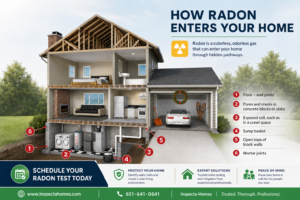
How Radon enteres your home

How Radon Enters Homes

Radon gas can seep into homes from the soil, rock, and water beneath or around the building.

Common entry points include:

  • Overheating and circuit overload issues in electrical and mechanical systems.
  • Energy inefficiencies such as heat loss due to poor insulation, air leaks in HVAC systems, and hidden water leaks within walls and ceilings.

How Radon Accumulates Indoors

  • Due to energy conservation efforts, many homes are tightly sealed, which reduces ventilation and can lead to increased radon levels indoors.
  • Radon in well water is another significant contributor to indoor pollution, especially in certain regions. Radon trapped in water is released into the air when water is agitated (e.g., during showers or while using washing machines).
  • When radon gas accumulates indoors, it decays into radon progeny—radioactive particles that can stick to dust. When inhaled, these particles can become lodged in the lungs and potentially cause cancer over time.
How Radon Accumulates Indoors

Conclusion

Radon is a serious public health concern due to its association with lung cancer. Awareness and testing are critical, especially in areas like Minnesota, where radon levels tend to be higher than average. Regular testing and mitigation are important steps to reduce the risks associated with this invisible, yet dangerous, gas.