
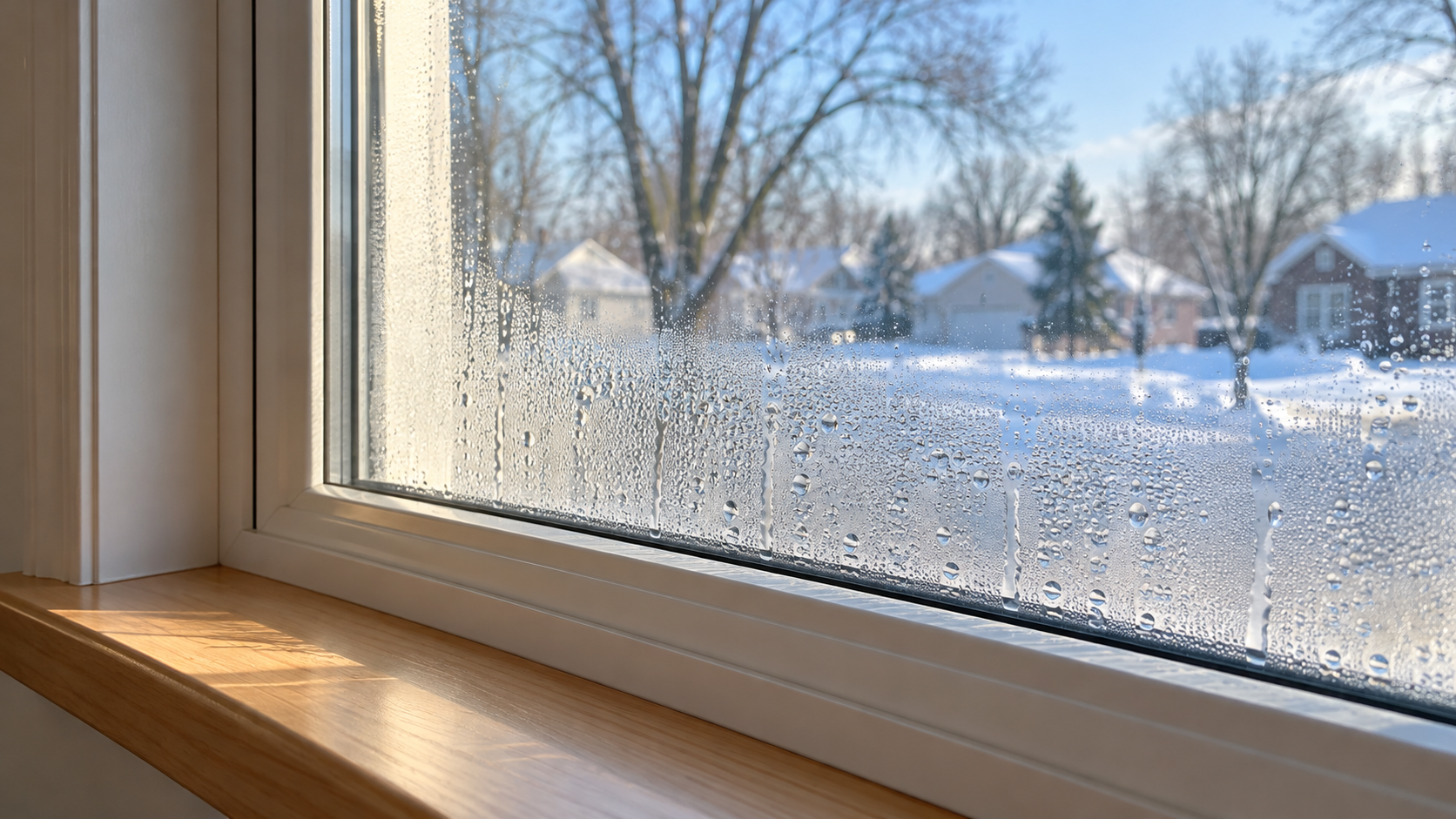
Understanding Window Condensation in Minnesota Homes
You wake up on a chilly Minnesota morning and notice droplets along the bottom of your windows. Is the glass leaking? Is the humidity too high? Do the windows need to be replaced?
The answer depends on where the moisture is forming. Condensation on the room-side glass, fogging inside a sealed glass unit, and water around the window frame can point to different concerns. Start by identifying the location before choosing a fix.
Why condensation forms
Condensation occurs when a surface is cold enough for water vapor in the surrounding air to turn into liquid. Think of the droplets that collect on a cold drink. During winter, window glass can become the cold surface inside your home.
Cooking, showering, and other daily activities add moisture to indoor air. Humidifiers add more. When that moisture meets cold glass, droplets or frost may form. Interior condensation alone does not establish that the window is defective, but repeated wetting deserves attention.
Where is the moisture
On the room side of the glass
If droplets wipe away from the inside surface, indoor humidity and the glass temperature are likely contributing. Heavy curtains or closed blinds can also limit warm room air reaching the glass. Note whether several windows are affected or only one room.
Between the panes of sealed insulated glass
Fogging that cannot be wiped away from either exposed surface may indicate a failed seal in an insulated glass unit. Lowering indoor humidity will not repair that seal. A window professional can confirm the condition and explain whether the glass unit can be replaced without replacing the entire window.
A separate storm window creates a different type of space. Moisture between a primary window and a storm window should not automatically be treated as an insulated-glass seal failure.
On the outside surface
Exterior condensation can form when outdoor moisture meets cool glass, much like dew on grass. This can occur on cool mornings and does not, by itself, establish a window defect.
Around the frame or on nearby walls
Water on the sill can be runoff from interior condensation. Wet trim or wall staining may also involve water entry around the window. Photograph the location and note whether it appears during cold weather, after showers, or following rain. Timing helps guide the investigation; it does not prove the source.
Practical steps to reduce interior condensation
- Measure indoor humidity. Use a hygrometer and record readings along with outdoor temperatures. Follow your window manufacturer’s cold-weather guidance; colder conditions may require lower humidity. A single setting will not suit every home throughout winter.
- Check humidifier settings. Reduce added moisture when windows repeatedly become wet or frosted. Follow the equipment instructions rather than leaving the same setting in place through every cold snap.
- Use bathroom and kitchen exhaust ventilation. Confirm that equipment intended to exhaust outdoors actually does so. A recirculating range hood does not remove moisture from the home.
- Allow room air to reach the glass. Open blinds or curtains periodically and keep heating registers unobstructed. Observe whether the moisture improves.
- Dry accessible wet surfaces. Wipe the glass and sill with a soft cloth so water does not remain against finishes. Drying limits repeated wetting, but the cause still needs attention.
- Have persistent concerns evaluated. An HVAC professional can assess ventilation or humidity-control equipment. A window contractor can evaluate glazing, seals, operation, and installation concerns.
When a closer look is needed
An occasional light film during a cold spell is different from water repeatedly pooling on a sill. Arrange further evaluation when you notice:
- Recurring heavy condensation or frost despite reasonable moisture-control steps.
- Peeling paint, swelling, soft wood, or staining around the opening.
- Visible growth, persistent musty odors, or damp nearby finishes.
- Fogging within a sealed insulated glass unit.
- Water appearing around the window after rain or snowmelt.
Avoid painting over damaged areas or sealing every opening around a window before identifying the cause. Some openings are designed for drainage. Repairs should follow the window manufacturer’s instructions and address the source of the moisture.
Questions for homebuyers
If you notice wet windows during a showing or inspection, ask when the condition occurs, whether it affects other rooms, what repairs have been made, and whether documentation is available. Ask the inspector which visible conditions warrant specialist follow-up.
Dry windows on inspection day do not establish how the home performs during a colder spell. A general home inspection documents accessible, visible conditions at the time; it cannot determine the condition of every concealed area or predict every seasonal moisture problem.
Get help understanding what you are seeing
Inspecta-Homes has served Minnesota and Western Wisconsin since 1981. If you are buying a home or have questions about visible moisture concerns, contact our team to discuss the appropriate inspection and any additional evaluation your property may need.
Call 651-641-0641 or visit inspectahomes.com to discuss your inspection needs.


